Giovanna Colosi G’16, G’24 is Librarian for the School of Education and Team Lead of Subject Instruction at Syracuse University Libraries, where she serves as the library liaison to SOE students, faculty, and staff.
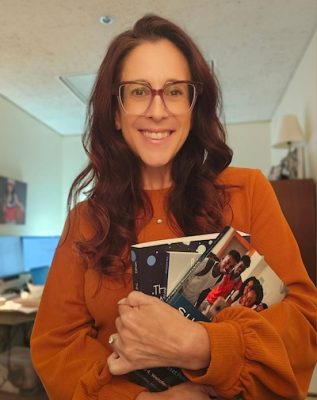 Colosi’s path to Syracuse began at SUNY Oswego, where she earned a bachelor’s degree in Psychology and an M.S. in Counseling and Human Services. Before earning her master’s degree, she was an assistant director of admissions at Cayuga Community College before moving to the College of Southern Maryland and Northern Virginia Community College, working as Director of Student Life and as a counselor, respectively.
Colosi joined Syracuse University as an academic advisor in the College of Engineering and Computer Science in 2009, before taking her master’s degree in Library and Information Science and joining the library staff in 2018. Colosi received her certificate in Disability Studies from the School of Education in 2024, and in 2026, she was named to Cohort 6 of the University’s Women in Leadership program.
Describe your current role and its responsibilities.
I wear many different hats and what I do varies day by day, which I absolutely love. Some of my duties include teaching research and information literacy sessions, I work individually with students and faculty on research, projects, dissertation help, and literature reviews. I also develop research guides and other instructional resources, support collection development, deliver research workshops to graduate students, and collaborate with faculty to integrate library resources and research skills into their courses.
A significant part of my work involves helping students become more confident and independent researchers. That can mean introducing a graduate student to a specialized education database, delivering a lecture in a research skills course, helping a doctoral student think through a complex search strategy, or teaching students how to evaluate information.
“Students are encountering AI tools everywhere, and librarians have an important role in helping them understand not only how these tools can be used but also their limitations.”
I also collaborate with staff and faculty members to assist with designing research instruction for courses, acquiring texts and resources for their courses, or any number of other projects where a librarian could be useful.
“Students are encountering AI tools everywhere, and librarians have an important role in helping them understand not only how these tools can be used, but also their limitations.”
How did the School of Education prepare you for this role?
The School of Education helped me think more intentionally about education, access, inclusion, and the different experiences students bring to learning. My inquiry in Disability Studies were especially influential, teaching me to think about accessibility proactively rather than simply as an accommodation after there are access issues. That perspective continues to shape how I teach, support students, create resources, and approach library services.
SOE also reinforced for me that education is about more than simply sharing information. It is about building relationships, meeting students where they are, and helping them develop confidence in their own abilities. That has been especially important in my role as a librarian, where I often work with students who may feel overwhelmed or unsure of themselves as researchers. I want them to leave an interaction with me not only with the information they need but also feeling more confident in their ability to find it themselves.
What current trends do you see in your specialty and how are you addressing them?
One of the biggest changes in academic librarianship, and in the world right now, is the rapid growth of artificial intelligence. Students are encountering AI tools everywhere, and librarians have an important role in helping them understand not only how these tools can be used but also their limitations. Questions about accuracy, bias, transparency, and ethical use are becoming part of information literacy.
At the same time, the information environment itself has become increasingly complex and complicated. Students have access to so much information, but more information does not mean researching is easier. Being able to evaluate a source, understand how information was created, how to recognize misinformation, and determine what constitutes credible evidence are increasingly essential skills.
I address these changes by making sure my lesson plans reflect the changing information landscape. Rather than focusing only on where students can find information, I want them to understand how and why information is produced, evaluated, and used.
“What stands out to me about SOE is how genuinely the faculty care about their students, not just as students, but as a whole person.”
Which professors stood out for you most as a student at SOE?
I had wonderful professors throughout my time at SOE, but Barbara Applebaum and Alan Foley particularly stand out. Both challenged me to think critically, examine my assumptions, and engage with perspectives beyond my own. Their courses helped me become a more thoughtful and reflective educator, and that mindset has stayed with me.
What makes it especially meaningful is that I now have the opportunity to work with professors Applebaum and Foley as colleagues in my role as SOE’s liaison librarian. There is something really special about having once been their student and now being able to support their teaching and research.
More broadly, I feel incredibly fortunate to work with faculty throughout the School. Getting to know and collaborate with SOE faculty in a completely different capacity has been one of the most rewarding parts of my role.
Make a pitch for SOE—why should a prospective student choose the School of Education?
Other than having access to a FANTASTIC liaison librarian?! Seriously, what stands out to me about SOE is how genuinely the faculty care about their students, not just as students, but as a whole person. There is a real sense that faculty want to know who you are, what matters to you, and where you hope your education will take you.
The School is also a place that prepares you for a career while challenging you to think more deeply about what it truly means to help people learn and thrive. And that preparation can take you in directions you may not have imagined when you first started.
I think my own career is a good example of that. I spent nearly 20 years working in higher education, primarily supporting students as an academic counselor. In 2018, I transitioned to librarianship after earning my M.L.I.S. from the iSchool in 2016.
While I may not be a traditional classroom teacher, teaching is still very much at the heart of what I do. And I truly am lucky to be a part of so many students’ academic journeys. My career path may have evolved in ways I did not initially anticipate, but what I learned through SOE continues to shape how I teach, support students, and approach my work every day.