
Educational Leadership, Ed.D.

Personal Transformation. Equity-Focused Leadership. Systemic Impact.

The online doctorate in Educational Leadership prepares educational leaders to drive equity-focused, transformational change across K-12 schools, school districts, colleges, and universities, and to develop new skills and insights while continuing their professional work.

Whether you are a principal or district administrator working to close opportunity gaps in your schools, or a mid-career professional in student affairs, academic services, or institutional leadership who wants to lead a division, direct a program, or shape educational policy, this degree is designed to meet you where you are.

Application Deadline: April 1 | More admissions information
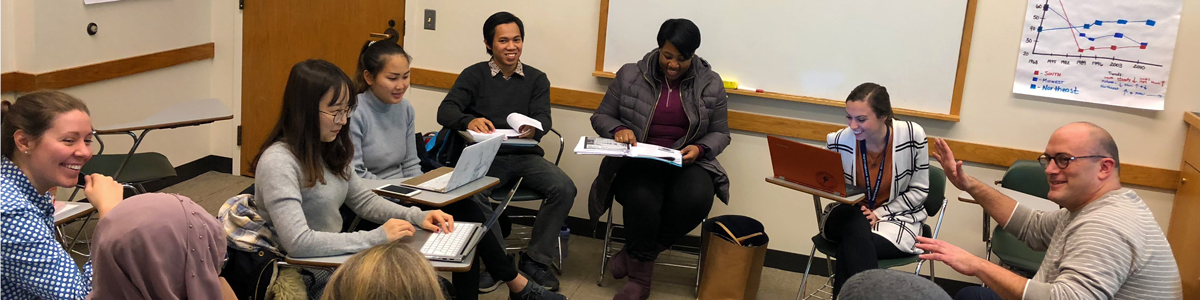
Educational Leadership students in class

Why Educational Leadership at Syracuse?

  • Built around your career. Fully online and structured for part-time study and completion in three years, this program allows you to continue your leadership role while building the scholarly and research skills that will define the next chapter of your career. No sabbatical or relocation required.
  • Two concentrations; one powerful cohort. The program brings together K-12 leaders and higher education professionals in the same cohort. The result is a rich, dynamic learning community in which school district and university administrators share perspectives, challenge assumptions, and build a professional network.
  • Applied research that solves real challenges. The program’s culminating capstone project is a rigorous, practitioner-focused inquiry into a critical issue in your own professional context and relevant to the communities you serve.
  • Organized around equity—Equity-focused, student-centered leadership is the program’s organizing principle. Courses such as Addressing Systemic Racism in Education prepare leaders to confront the structural barriers that limit student success and to lead institutions that are genuinely inclusive.
  • Faculty who are active scholars in the field. As an R1 research institution, Syracuse University attracts faculty whose work shapes national conversations in educational leadership, equity, and higher education and whose professional networks become part of your own.

Moshiena Faircloth“Syracuse University’s phenomenal Ed.D. in Educational Leadership program transformed me as a scholar and as a person. Through rigorous research, deep self‑reflection, and the steady perseverance, I learned what it truly means to engage in meaningful, lifelong inquiry. Faculty helped me shape research that doesn’t end with a degree but becomes part of who I am and how I lead, learn, and serve.”
—Moshiena Faircloth G’25

Who Should Apply?

Our cross-sector cohort model—in which students in both concentrations share a core curriculum and progress together—is one of the program’s distinctive strengths:

  • K-12 leaders: principals, assistant superintendents, curriculum directors, and other school and district administrators ready to bring doctoral-level research, equity frameworks, and leadership theory to the high-stakes environments of urban, suburban, and rural school systems, and to position themselves for the most senior roles. Through this program, K-12 leaders earn a world-class doctorate in an accessible timeline.
  • Higher education professionals: student and academic affairs professionals, enrollment managers, and institutional leaders at the mid-career stage who aspire to senior and executive-level positions at colleges and universities. The program’s scholar-practitioner model addresses competencies that define campus leaders, including evidence-based practice, program evaluation, and equity-centered leadership.

Program at a Glance

The Ed.D. in Educational Leadership requires 60 credits of coursework and is structured to be completed in three years. Students who hold a certificate in educational leadership or a qualifying master’s degree may transfer up to 30 prior graduate credits (total credits will vary accordingly). Students who do not hold these credentials will complete additional prerequisite coursework.

  • Designed for working professionals. The program is delivered entirely online, designed for professionals at the mid to senior level who want a doctoral program that fits demanding schedules.
  • Two sector-focused concentrations. Students choose between the K-12 Educational Leadership concentration, which builds on prior school leadership preparation, and the Higher Education concentration, which is designed for professionals working in higher education leadership roles.
  • Peers who push you forward. Students in each cohort take shared courses alongside concentration-specific coursework. Cohort seminars—taken across multiple semesters—provide structured peer support, accountability, and a collegial network that extends across the K-16 educational landscape.
  • Research methods that match your needs. The capstone project is designed to produce solution-driven scholarly work ready to be implemented in schools, colleges, and communities. Students choose two research methods courses from a menu that includes qualitative and quantitative inquiry, community-engaged methodology, and survey research, allowing them to develop the methodological skills most relevant to their capstone and professional context.

More information on academic requirements available in the Syracuse University Course Catalog.

What Our Graduates Do

Educational Leadership graduates hold senior leadership positions across the K-16 educational spectrum:

  • Superintendents and assistant superintendents in school districts across New York State and nationally.
  • District-level directors of curriculum, instruction, and equity.
  • Principals and school leaders in high-complexity K-12 school systems.
  • Vice presidents for student affairs and deans of students at colleges and universities.
  • Directors of academic support, access, success, and enrollment management programs in higher education.
  • Senior administrators in student affairs, residential life, and campus diversity and inclusion offices.
  • Educational policy advisors, consultants, and researchers.
  • Faculty and academic administrators in schools and colleges of education.