Jared Khan-Bagley ’22, G’23 graduated Syracuse University School of Education with a B.S. in Inclusive Elementary and Special Education and an M.S. in Inclusive Special Education (Severe/Multiple Disabilities). At Syracuse, he was a Posse Foundation scholar, a 2021-2022 Remembrance Scholar, and a Peer Mentor in the InclusiveU program.
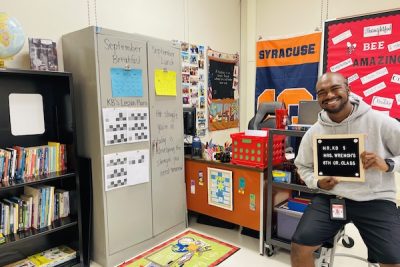 Currently, he is a secondary special education teacher in the Baldwinsville (NY) Central School District, serving students in 12:1:1 and 15:1 staffing ratio special class programs.
Describe your current role and its responsibilities.
As a secondary special education teacher, I support students with severe and multiple disabilities within inclusive educational settings, focusing on individualized instruction, academic growth, and meaningful participation in school life. I work alongside a dedicated team of teaching assistants who share a commitment to creating supportive, student-centered learning environments.
How did the School of Education prepare you for this role?
One of the greatest strengths of SOE’s inclusive education programs is the commitment to preparing future educators through extensive field experiences in a variety of educational settings. By placing teacher candidates in multiple school districts, the program provides valuable opportunities to gain hands-on experience, build foundational teaching skills, and develop an understanding of how different school systems operate.
I completed placements in several Syracuse-area school districts, including city schools, Jamesville-DeWitt, North Syracuse, Liverpool, and Baldwinsville. While each district has its own initiatives, priorities, and approaches to programming, they all share a common goal: supporting students and fostering their success. These diverse experiences broadened my perspective as an educator and helped shape my approach to meeting the unique needs of all learners.
What current trends do you see in your specialty and how are you addressing them?
“One of the greatest strengths of SOE’s inclusive education programs is the commitment to preparing future educators through extensive field experiences in a variety of educational settings.”
Inclusion is at the heart of education today, and it is the foundation of how we, as an educational team, support all students and their families within our learning environments. Creating inclusive opportunities for every learner is not just a goal, it is a commitment that guides our daily work.
In my district, communication and collaboration are essential, and they are strengths that we value deeply. Meaningful conversations among educators, families, support staff, and students help us build a comprehensive understanding of each learner’s strengths, needs, and aspirations. We focus on each student’s individual potential and work together to make the necessary adjustments, accommodations, and supports that allow them to thrive academically, socially, and emotionally.
By maintaining a student-centered approach and fostering open communication, we create learning environments where all students feel valued, supported, and empowered to succeed.
Which professors stood out for you most as a student at SOE?
The Taishoff Center for Inclusive Higher Education played a pivotal role in shaping my understanding of inclusive education, particularly in the area of post-secondary education. Through its commitment to creating meaningful opportunities for individuals with disabilities, the center established a strong foundation for what true inclusion can look like across educational settings.
The work and leadership of Taishoff Center Executive Director Beth Myers and her exceptional team have advanced the principles of inclusion and demonstrated how these practices can be implemented to ensure all learners are valued, supported, and provided opportunities to succeed. Their dedication has served as a model for creating inclusive environments that extend beyond higher education and into K-12 classrooms.
In addition, the guidance and expertise of faculty members including professors Myers, Christy Ashby, Tom Bull, Jill Christian-Lynch, Sharon Dotger, and George Theoharis provided me with a breadth of knowledge that prepared me to become a reflective and effective educator. Each brought a unique perspective on teaching, learning, leadership, and equity, encouraging me to view education through multiple lenses.
Their collective influence helped shape my philosophy of inclusive education and equipped me with the skills and mindset needed to support diverse learners in meaningful and impactful ways.
Make a pitch for SOE—why should a prospective student choose the School of Education?
If you’re looking for a challenge and an opportunity to grow both personally and professionally, the School of Education is the place for you. What sets the program apart is its emphasis on open dialogue, meaningful discussion, and authentic field experiences. Rather than simply learning about education in a classroom, students are immersed in the real work of teaching through placements in multiple school settings throughout the program.
These experiences provide firsthand insight into how education operates across urban, suburban, and rural school districts, allowing future educators to see the similarities, differences, and unique challenges each setting presents. The combination of rigorous coursework and extensive fieldwork encourages students to continuously reflect on and refine their educational philosophy.
SOE challenged me to think critically, engage in thoughtful discussions, and consider multiple perspectives on teaching and learning. Most importantly, as those conversations were grounded in real-world experiences, the learning was both meaningful and impactful. SOE is a place that pushes you to grow as an educator while preparing you to make a difference in the lives of students.