
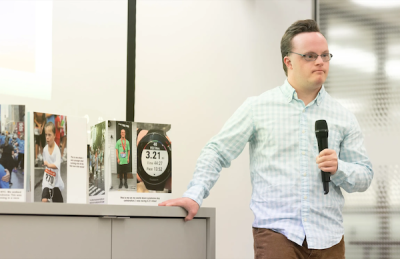
Aidan Samsel ’27, a Syracuse University InclusiveU student, values friendships—and wants to make it easier for young adults who struggle to connect with others.
His solution: develop a friendship app called “Pod Finder” where users meet and interact in small online groups called pods. With the support of a pod guide—a trusted family member or friend who monitors activity and ensures safety—members can build connections at their own pace and eventually arrange in-person meetups. “The app will help people make friends, feel included and not be lonely,” Samsel says.
Samsel’s creation was one of the projects featured this semester in Intelligence++, an innovative, interdisciplinary initiative that introduces InclusiveU and matriculated students to inclusive design, entrepreneurship, and community—with the goal of developing devices, products and services for those with intellectual and developmental disabilities. “This team has done a fantastic job really thinking through accessibility all semester,” says Beth Myers, the Lawrence B. Taishoff Associate Professor of Inclusive Education and Executive Director of the Taishoff Center for Inclusive Higher Education in the School of Education.
Myers co-teaches the course with Don Carr, an industrial and interaction design (IID) professor in the College of Visual and Performing Arts. The initiative reflects a synergistic union of the University’s historic strengths in disability rights, innovation, and entrepreneurship.
Founded in 2020 with the support of renowned designer Gianfranco Zaccai ’70, H’09 and the Zaccai Foundation for Augmented Intelligence, Intelligence ++ is an integral part of the entrepreneurial ecosystem on campus. In 2023, Zaccai expanded the initiative with Intelligence++ Ventures, a fund that provides grants for students who want to further develop and commercialize products conceived through Intelligence++.
“All of these resources at Syracuse University can contribute to the creation of innovative products and services that support individuals throughout their lives,” Carr says.
“All of these resources at Syracuse University can contribute to the creation of innovative products and services that support individuals throughout their lives.”
Professor Don Carr
Fashioning Inclusive Clothing
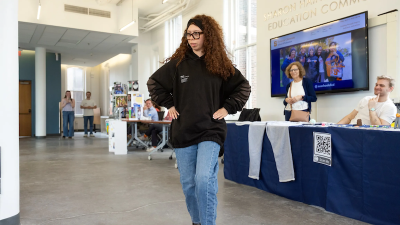
One venture that has traveled this entrepreneurial path is SOLACE Collective, an inclusive clothing brand dedicated to stylish garments with sensory-friendly features. Recognizing how uncomfortable clothing—itchy material, tags, and seamlines—can distract and bother neurodivergent individuals, SOLACE Collective pursued a clothing line to provide comfort, confidence, and style, receiving support from Intelligence++ Ventures and other University entrepreneurship competitions.
“We spent about a full year working with groups like Intelligence++ and InclusiveU, really focusing on developing the garments with the neurodivergent community here because they have heightened sensory sensitivities,” says Aidan Turner ’25, who co-founded the company in December 2024 with Carolyn Fernandes ’25 and Lucas d’Oelsnitz ’25. “We were able to have great conversations and really work on the products to make them shine.”
In April, SOLACE Collective hosted the Inclusive Fashion Expo at the School of Education, with InclusiveU students modeling the company’s designs. “There’s nothing more rewarding and fulfilling than creating a business that truly helps people who are often overlooked through fashion,” Turner says. “Fashion is not very inclusive, and we are trying to change the world here. And being supported by Syracuse University means everything to us.”
Advancing Communication Access
While studying in Intelligence++ a few years ago, IID major Domenic Gallo ’24 worked alongside InclusiveU student Chase Coleman ’27, who is inconsistent with verbal speech and uses a tablet with augmentative and alternative communication (AAC) functions. Seeing the limitations of AAC tools firsthand inspired Gallo to launch a design research project exploring how incorporating emerging technologies in AAC tools could improve communication for nonspeaking individuals.
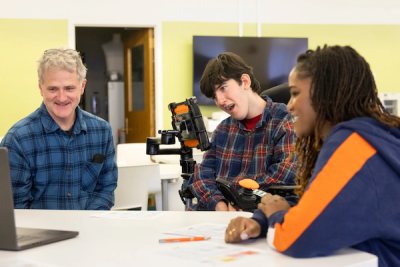
Gallo’s project planted the seed for an Intelligence++ collaboration this semester. In the independent study course Innovations for Humanity, biomedical and chemical engineering professor Pun To “Doug” Yung introduced students to the idea of advancing AAC tools. While tablets typically require typing and are accompanied by a synthesized voice, Yung challenged his students to envision product features that reflect a user-friendly approach enhanced by artificial intelligence (AI), supporting conversation that would share emotion and promote attentiveness and understanding. “The emphasis is on translating inclusive design principles into functional technologies that support communication, accessibility, and human dignity,” Yung says.
Through a series of meetings, biomedical engineering majors Alex Keysor ’27 and Samara Tomlinson ’27 and mechanical engineering major Gavin Johnson ’26 worked with nonspeaking consultants and their caregivers, including Coleman, InclusiveU alumna Maia Chamberlain ’23 and Jamesville-DeWitt High School junior Leo True-Frost. By getting to know the consultants, the students learned about their current communication methods and developed AAC prototypes based on feedback.
Keysor focused on an interface that would allow the user to convey an emotion through their synthesized speech, with AI-generated contextual follow-ups. The system would also simplify complex communication for the user to improve understanding. “I was really excited to get the chance to do hands-on work, and I wanted the chance to help people,” Keysor says.
Bring People Together
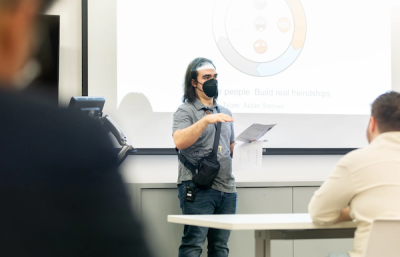
Tomlinson created a platform that would use AI and sensors to improve scheduling, identify communication partners and locations, and provide a safety alert system. Tomlinson appreciated the feedback she received from Chamberlain and her support team. “It really makes a difference to see them excited about my idea,” she says. “Engineering is to bring people together.”
Johnson designed an AAC screen-sharing system to improve conversation between the user and a communication partner, especially in a school setting. It would convey the user’s emotion, track the user’s message status for the partner, and keep the partner present in the moment. With repeated use, AI would learn the user’s language patterns and aid with responses, he says.
For Intelligence++, every step taken to improve accessibility and inclusion is welcomed progress. “Our understanding of how each of us processes information differently and how the use of AI tools can ‘sense our needs’ makes this an exciting time to innovate in this space,” Carr says. “Gone are the days of creating one-size-fits-all solutions that only support a percentage of the population.”
Originally published by Syracuse Stories. By Jay Cox.