One of the most meaningful experiences retired Lt. Col. Marc Cleveland recounts from his career in the US Army was his first deployment, when he served as a platoon leader in Afghanistan.
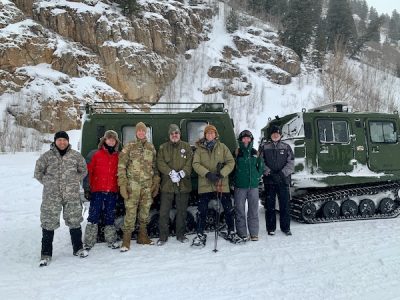
“We were a group of guys with such diverse backgrounds—really different childhoods, really different life experiences. At the time, it was eye-opening for me to realize how much we had in common, despite those differences,” Cleveland says. It was through getting to know his fellow soldiers that Cleveland first started to appreciate how significantly lives are shaped by systemic forces and access, or lack thereof, to networks of support.
This insight was, in part, what inspired Cleveland—now retired from active duty after 20 years of service as infantry officer, signal officer, and eventually information operations officer—to enroll in Syracuse University’s online master’s program in social work through the School of Education.
Military-Friendly
For Cleveland, the online M.S.W. program felt like a natural way to extend the profound education he gained through his military experiences into a new form of service: “I’m really lucky to have gotten through everything we experienced, and I appreciate all the lessons I learned from those experiences. The social work program allows me to build on that learning and gained wisdom and positions me to leverage it toward helping people.”
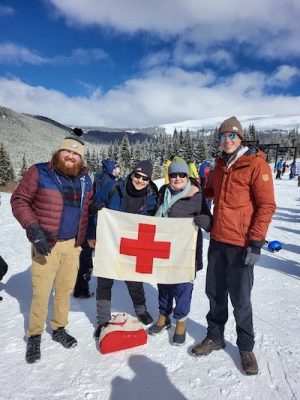
Although originally from Texas, after commissioning as an officer Cleveland chose to serve with the 10th Mountain Division, based at Fort Drum in the North Country of New York State. After retiring, he was invited to become Executive Director of the 10th Mountain Division Foundation, which is charged with preserving the history and celebrating the legacy of this legendary unit of the Army.
In this role, Cleveland began collaborating with the University’s D’Aniello Institute for Veterans and Military Families on leadership and programming opportunities for students and veterans. During these exchanges, what Cleveland learned about Syracuse intrigued him: “I got a sense of how military-friendly the University is, but also the interactions with students and faculty really impressed me, and I realized I wanted to be part of this community.”
“I got a sense of how military-friendly the University is, but also the interactions with students and faculty really impressed me, and I realized I wanted to be part of this community.”
Make Things Better
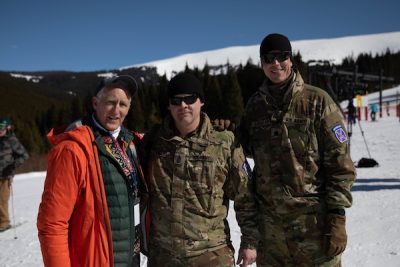
“When I was in college, I really was not a great student,” Cleveland concedes. Being a student now though—in his 40s and after a full career—has been exhilarating, he says, because he so appreciates what he’s learning.
Particularly fascinating have been courses that illuminate different aspects of identity formation and social context and the ways that policy can dictate the conditions of people’s lives. Cleveland says these lessons have given him new frameworks for understanding what he realized all those years ago, when his military experiences first prompted him to reckon with the diversity of lived experiences.
One concept Cleveland has come to particularly appreciate is that of “allyship”. “Allyship describes the effort of taking one’s privilege and power and using it for the benefit of others,” he explains. “I feel that’s what a lot of social workers are for other people. In this profession, we want to make things better.”
Two Worlds
Cleveland values the flexible breadth of the field of social work. “You can practice social work at micro, meso, and macro levels. Meaning, if you want to affect broad change, you go for policy. If you want to work one-on-one with an individual, you can do that too.”
Of equal importance to him has been the flexibility of his M.S.W. program. Because it is part time and online, Cleveland has been able to remain in Watertown with his wife and family and continue to lead the 10th Mountain Division Foundation.
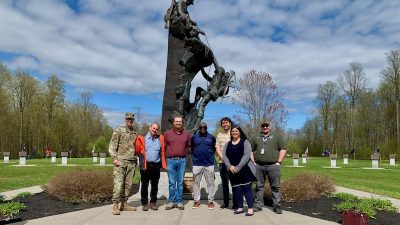
That balance has opened up opportunities for integration between his two worlds—including a collaboration he helped orchestrate between the School of Information Science and the Foundation on a project to document veterans’ oral histories.
Past and Future
Among the challenges veterans face when transitioning from military to civilian life, Cleveland explains, is leaving a world where systems and processes are clear and predictable for one where bureaucracies can be obscure and complex.
He sees his military training in effective systems, combined with his recent experience in nonprofit leadership, as a reservoir he hopes to draw from as a social worker to help communities and individuals—including veterans—navigate the systems they encounter and access the resources they need for their wellbeing.
Cleveland says that everything he’s learned, in and out of classrooms, has cultivated his appreciation of interconnectedness, “As I see it, nothing that happens and nothing that we experience happens independently. You can’t isolate problems; you have to look at them holistically and try to solve them holistically, as well,” he explains.
This philosophy underpins how Cleveland sees the evolving connections in his own life, as well. For Cleveland, the online master’s in social work allows him to connect his past and his future in a meaningful way through a love of learning, a commitment to service, and a deep appreciation for human connection and community.
By Sarah H. Griffin
Learn more about the on-campus or online M.S.W. in Social Work programs.