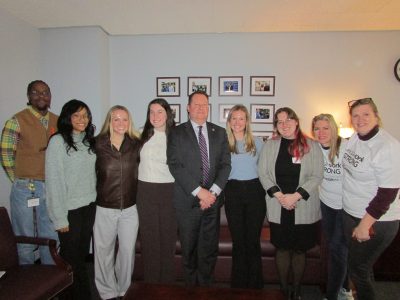
Capitol Action Day is the National Association of Social Workers-New York’s (NASW-NY) annual advocacy event, connecting social workers directly with the legislators whose decisions shape the profession and the communities it serves. For students in the School of Social Work, it is also a vivid, hands-on introduction to macro practice, the systems-level work that complements personalized, clinical care.
Re-published from Education Exchange 2026.
In February 2026, among the students making the School-sponsored trip to Albany— led by Joseph L. Smith, Associate Teaching Professor in the School of Social Work—was Jessica Edwards G’26. Edwards is a graduate of the online, part-time M.S.W. program and serves in the Office of Institutional Equity at Upstate Medical University in Syracuse.
As Edwards describes, she is exactly the kind of advocate NASW-NY is hoping to cultivate: someone who came to social work through personal experience, found her voice in a graduate policy course, and then showed up to make her profession’s case to her elected representatives.
Q: What drew you to social work?
A: Around 2016 I became really interested in social work because my mom was suddenly debilitated. I found myself navigating systems such as disability services, and it was a social worker who was really helpful. She helped me understand what resources are out there—often you need someone who can communicate that information to you.
“We were already engaging with policy every day, whether in our workplaces or our communities. We kept leaving class asking how do we talk to who is making these policies?”
Through that experience, and through my own work in the therapeutic space, I realized I really enjoyed helping people. I worked at the Loma Linda University School of Pharmacy in California, where I placed students in clinical rotations. I realized I needed to understand their backgrounds too, such as did they have other complexities going on? I got a real passion for helping people and making sure they knew resources were available.
When I became Executive Assistant to the Cornell University Dean of Students, working with undergraduates, I realized I wanted to be the person they came to for support and not just an administrative assistant. I felt comfortable in crisis situations, probably because of my past experiences. So I decided to go to school for this kind of work.
Q: Why did you become interested in policy and advocacy?
A: A lot of people feel like processes are just in place and don’t ask, “Why?” or “Is this process in place because someone made a decision?” In his welfare policy course, Professor Steven Bush would ask, “If your clients were in this situation, how would it affect them? Who does this impact?”
A lot of us were scared of the word “policy,” but we found we actually had a lot of opinions and experience. We were already engaging with policy every day, whether in our workplaces or our communities. We kept leaving class asking how do we talk to who is making these policies?
Even though it was dispiriting to learn about policies impacting vulnerable populations, being aware was so valuable. It humanized policy. We created presentations that gave us practice formulating ideas, thinking about language, and how to approach someone who doesn’t understand social work.
Q: Why join Capital Action Day 2026?
A: Professor Bush told the class, “Don’t be afraid to show up in policy spaces. Run for political positions.” So when Professor Yvonne Smith emailed saying the School is offering a free bus ride to Capital Action Day, I thought, “Okay, maybe I’ll go.”
I attended the preparatory meetings telling myself maybe I might pull out. But I’ve learned to move through fear and just do things anyway. Before I went, I emailed Pamela Hunter (D-128), my assembly member, and asked if I could meet to talk about some priorities NASW-NY is working on.
One of the best parts of the day was meeting other students, including residential M.S.W. students. Just listening to their perspective was great. The atmosphere at the Capitol was spectacular. There were so many kinds of professionals: doctors, pharmacists, students advocating to let 17-year-olds vote. All different ages, all different causes.
Inside the building, we made posters and got to meet other social workers. I think it was so important for us to be in the same space together because as a student, you are often learning about what’s wrong with the system. Seeing everyone so energized was really powerful.
Q: Which NASW-NY issue seemed to get most traction?
A: When we met with Sen. Chris Ryan (D-50), what struck me was that many representatives already have personal connections to the issues. They have family members who are teachers and who work with students with special needs, so they aren’t unfamiliar with what we were advocating for: making sure social workers can show up fully supported and ensuring students have access to basic mental health services.
I shared what I had learned in my research: that for many students, services provided at their public school are the only mental health services they will ever receive. Not every school in Syracuse has a social worker, and that has a real impact, especially for parents working multiple jobs who are dealing with their own mental health challenges. That message wasn’t hard to land with the representatives.
I also met with Assemblymember Sam Berger (D-27), co-sponsor of several of these bills. He is incredibly open to working with social workers, so that conversation wasn’t about proving a point, it was about sharing experiences. One thing he said really stuck with me: personal stories stay with representatives. When someone emails and says, “A social worker helped me through this specific situation,” those stories matter.
Q: Have you had any follow-ups since the event?
A: Although I couldn’t meet with Assemblymember Hunter on the day, a few weeks later her office reached out and asked if I still wanted to meet with their legislative coordinator to discuss the NASW-NY priorities. I said absolutely! I had support from NASW-NY’s Advocacy and Government Relations Committee because it was my first time meeting with a legislator’s office, and it was a little intimidating.
I also was invited to join the NASW-NY Advocacy and Government Relations (AGR) Committee and to participate in a follow-up meeting with Assemblymember Berger, who is drafting legislation to address the shortage of social work supervisors, which affects practicum placements, an issue he raised during our discussion.
One bill that did seem to generate real engagement was the artificial intelligence oversight bill, which came out of a heartbreaking case involving a young person who took his life following disturbing conversations with AI. The child’s mother came to speak about it, and that personal testimony clearly landed with the representative.
Learn more about the master’s in social work program, or contact SOE Graduate Admissions at soeadmissions@syr.edu.