After several years as an unofficial study abroad opportunity, Syracuse University’s RECOS Trinational Seminar returns in 2026-2027 as a credit-bearing course, giving Master of Social Work students the chance to study their profession alongside peers from six European universities.
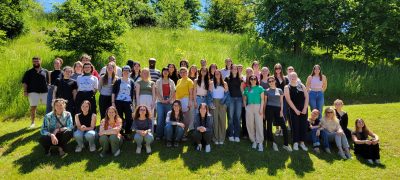
The annual Confédération des Ecoles Supérieures en Travail Social de la Regio—which translates as the Confederation of Universities in Social Science in the (Alsace) Region, also known as RECOS—brings M.S.W. candidates together with faculty and students from across three borders to discuss a social work topic of concern.
Assistant M.S.W. Online Field Director Kristin Esposito G’97 inherited the offering from Professor Emerita Nancy Mudrick, kept the program alive during and after the coronavirus pandemic, first by encouraging students to attend a truncated, virtual offering and later by inviting interested students to attend as a value-added field experience.
Different Perspectives
The seminar is an annual week-long cultural exchange in spring, convening approximately 60 social work students from France, Germany, and Switzerland, with an additional 10 spots for Syracuse students.
“When students have the chance to explore complex problems from different perspectives, they expand their thinking, exchange ideas, and build lasting relationships.”
Professor Kristin Esposito G’97
Hosted on a rotating basis in France and Germany, students visit agencies, discuss a shared social issue, and compare approaches. “It’s an intensive week,” says Esposito, noting students visit different social agencies and then come back together each evening to share what they learned. “This really expands the reach of knowledge.”
Esposito believes that making the seminar an official offering creates meaningful opportunities for student growth and connection.
“When students have the chance to explore complex problems from different perspectives, they expand their thinking, exchange ideas, and build lasting relationships that enrich their learning experience in an increasingly interconnected world,” she says. “I believe those experiences help shape how students approach future challenges and opportunities in their work.”
The seminar is returning as a component of Esposito’s Topics in Advanced Social Work Practice and Policy course, which is open to both undergraduate and graduate students in the Social Work program, offered through the School of Education.
Especially Beneficial
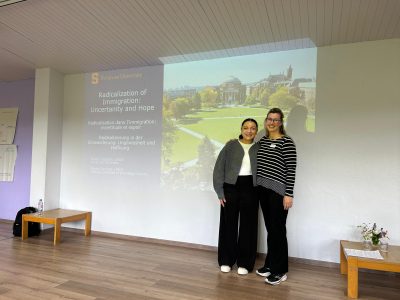
Allyson Donovan G’26, who participated in spring 2026, says the seminar was the perfect capstone to her degree because it provided a firsthand look at classroom theory in practice. “I felt like it brought a wider perspective into the program,” she says. “One thing we don’t touch on as much during class is what social work looks like on a global scale; this makes the seminar especially beneficial for students on the Advanced Integrated Practice M.S.W. track.”
Donovan explains that visiting social service agencies in Alsace, a region in northeastern France that borders Germany and Switzerland, gave a firsthand account of how political, economic, and cultural contexts shape practice.
She adds that one key takeaway from this year’s theme of Radicalization in Social Work was the importance of being attuned to the current political climate. By having a basic understanding of global politics, a practitioner can better help clients and navigate policy guiding one’s work.
“With the focus on global tensions happening in the world right now, I learned the importance to tune into how different cultures are coming into agencies and to be ready to take that on,” Donovan says.
One challenge for Esposito and her students is the language barrier and especially translation. Nevertheless, having discussions in French or German, Donovan says, made her focus on the message being relayed.
While she uses a live translation feature on her AirPods, exact translation isn’t always accurate. “You really have to tune in and stay present,” she says, which makes observations and leaning on the others in her group valuable. The serendipitous benefit of this translation challenge, attendees find, is that strong connections develop quickly.
Diverse Thinking
Cultural competence, says Esposito, is at the top of the list of benefits in attending. “It’s abundantly apparent that we work on a global stage in social work,” she says. “Learning alongside students, faculty, and community partners gives students access to diverse ways of thinking and problem-solving that extend beyond what is typically possible in traditional classroom settings.”
Nicole Corrente G’25 says the seminar was the main factor in her choosing Syracuse: “Discovering this program landed me at Syracuse University because no other graduate program in New York State had something similar to RECOS. I’ve always had a great interest in international work.” She even attended twice, first as a student in 2024 and later as a co-presenter.
“Discovering this program landed me at Syracuse University because no other graduate program in New York State had something similar to RECOS.”
Nicole Corrente G’25
As a student, the topic covered was Sex and Social Work. Corrente says she found it very interesting to witness each countries’ approach on a macro level: “What I loved most about that trip, was getting to travel to each of these countries and hear from workers in either governmental positions, nonprofit organizations, or grassroots, on how they address social work from a social welfare perspective.”
At this year’s seminar, she spoke on her experience with Catholic Charities of Onondaga County as a social worker for the Services for Afghan Survivors Impacted by Combat (SASIC) program, where she provides mental health support services to Afghan refugee families resettled in Central New York following conflict-related displacement.
Deeply Immersive
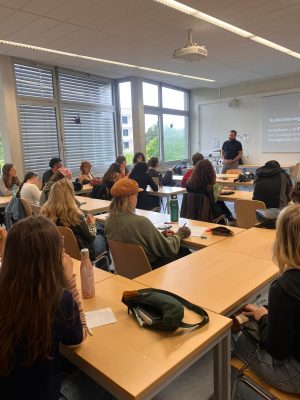
Grace Pierpont ’26, who attended this year’s seminar as an undergraduate student, enjoyed such interactions most. “It was amazing being able to connect with graduate students and international students in similar fields,” she says. “It was a perfect networking opportunity and a great way to gauge preparedness for my graduate level coursework.”
Pierpont adds she gained greater insight on how students, government agencies, and social work professionals in European countries perceive social issues and enjoyed sharing her own insight with international students who sought her perspective on the current US political climate.
The 2027 seminar, with a focus on Aging Populations, will be hosted in Germany and welcome up to 10 Syracuse students from Esposito’s course. The seminar week will be followed by another at the University’s center in Strasbourg, where students will learn more about policymaking in Europe and complete a reflection paper.
“In Strasbourg, our goal is to create a deeply immersive experience centered in one city in the Alsace region,” Esposito says, noting students visit the Council of Europe, European Parliament, and the Court of Human Rights, learning how the European Union collectively responds to protecting and advancing human rights.
That week is also utilized as writing retreat, with students required to complete a reflection paper on their entire experience as their final assignment. “We come away from this experience thinking differently,” Esposito says. “Our time with together sparks new ideas and approaches for how we might solve or address complex challenges.”
By Ashley Kang ’04, G’11 (a proud alumna of the M.S. in Higher Education program)
Learn more about the master’s in social work program, or contact SOE Graduate Admissions at soeadmissions@syr.edu.