
Coco Wing Yun Wong G’27, a Clinical Mental Health Counseling master’s degree student and a former graduate student employee in Health Promotion at the Barnes Center at the Arch, has been named the 2026 recipient of the Charles Schaefer Play Therapy Scholarship.
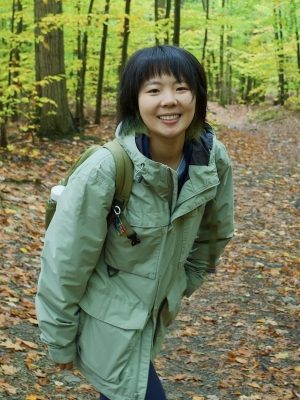
This award is given to just one student nationally each year by the Foundation for Play Therapy. Named in memory of Dr. Charles Schaefer, a co-founder of the Association for Play Therapy, the scholarship provides $5,000 toward training and supervision as Wong works toward a Registered Play Therapist credential.
Wong’s path to the field began in high school in Macau, China, where a single picture—of a colorful room full of toys, a child, and a play therapist—stuck with her long before she had any formal training.
That interest carried her through an undergraduate degree in psychology at Peking University, a gap year that included two months as a full-time volunteer supporting children and adolescents with developmental disabilities in Yunnan, China; two full-time jobs in Macau (one in a residential setting for adults with substance use disorders; one as a pre-school counselor); and, eventually, a weekly ferry commute from Macau to Hong Kong, the closest place she could find training in Child-Centered Play Therapy (CCPT).
In this interview, Wong talks about the scholarship’s importance, what play therapy is (and is not), her experience studying with the School of Education, and her future goals.
Q: What does this scholarship recognition mean to you?
A: Play therapy is one of my biggest passions, so this means a lot. Pursuing a career in play therapy has not been easy, and the term was not widely understood in Macau.
When I needed to complete my practicum there, I had to fight against all odds to coordinate with the agencies to secure a space for play therapy, find my own clients, and handle everything myself.
There were a lot of challenges, so this scholarship is validating. The acknowledgment of all that effort and sacrifice means the most to me.
Q: How would you describe play therapy to someone who has never heard of it?
A: When most people picture counseling, they imagine two people sitting in chairs, talking. Talk therapy works well between adults, because adults can use words, which are abstract symbols, to express feelings.
“As the therapist, I take a non-directive, empathetic, and reflective stance rather than directing the play.”
But young children, typically between the ages of 3 and 12, are not developmentally ready for that. You cannot expect a young child to sit in a chair and use words to talk through all their stresses and concerns. CCPT is a counseling approach where the therapist provides developmentally appropriate materials that let the child freely express themselves and direct their own play.
As Garry Landreth—one of the most important figures in the field of Child-Centered Play Therapy—put it: toys are children’s words, and play is their language. It is the most natural medium of communication for them. Children directly “play out” their experiences and feelings that cannot be expressed at a verbal level. Within that safe relationship, children move toward more self-enhancing ways of being.
Q: What does a typical play therapy session look like?
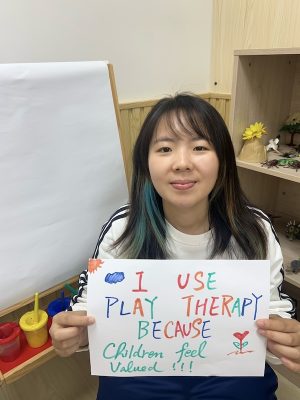
A: The room is full of different, developmentally appropriate toys, and every toy is chosen with a purpose. We ask, “Would this toy help a child express themselves?” We do not just fill the room with everything.
There are really three main categories. First, there are real-life and nurturing toys, such as animal families, baby dolls, furniture, play kitchens, and pretend play materials like medical kits and blocks. These allow children to act out different roles within family contexts and meet nurturing-related needs.
Second, there are aggressive and scary toys. Aggressive toys—such as toy guns, knives, handcuffs, or army figures—help children fully express anger and other difficult, intense feelings, while scary toys, such as sharks and snakes, help them express and process fears and anxiety. We also have a stand-up punching or bop bag, which we sometimes call a “Bobo.” Children will play with it in many ways, not necessarily just aggressively.
Parents sometimes worry these toys might make children more aggressive. However, when children are provided a safe space to freely release and process these intense feelings in the playroom, they often have less need to act them out in their daily lives because their needs are met during the play therapy session.
Third, there are creative and expressive toys, which include various art materials. These are used to express both positive and negative emotions. Children are often very creative and will use any of these toys to express feelings in ways you cannot always predict.
In a first session, we introduce the child to the room as a place where they can play with the toys in lots of ways. Some children are hesitant or nervous; others are comfortable right away.
As the therapist, I take a non-directive, empathetic, and reflective stance rather than directing the play, although I will join in if the child invites me to. It is less about passively following the child and more about “being with” them, genuinely feeling and understanding what they are expressing, matching their affect, staying attuned to their nonverbal cues, and letting my presence communicate that I am fully here with them.
Q: What’s a misconception about play therapy you would like to correct?
A: People think it means playing video games with kids. There are no video games or board games. We believe the toys we use are enough for children to express themselves, serve a therapeutic purpose, and help build the relationship between us. Games with rules, on the other hand, can limit a child’s creativity.
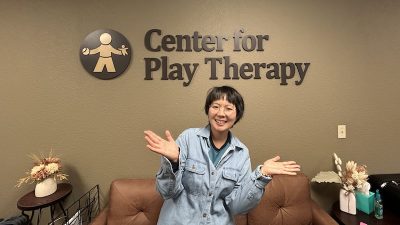
The second misconception is the idea that the therapist “does nothing” and just sits there reflecting. In fact, we are trained in child development and in delivering therapeutic responses to a child’s play, such as tracking, reflecting feelings, and esteem-building.
The playroom is a more accepting and non-judgmental space than school or home, where a child might already carry labels—”I’m messy,” “I’m naughty”—with specific expectations to live up to. In the playroom, none of that applies. This is a special time and space just for them, where they are accepted no matter what they are feeling, be it aggressive, angry, afraid, anxious, or shy.
Parents sometimes ask, “We have all these toys at home; why do they need to come here to play?” Often, by the time a family reaches play therapy, they have already tried other approaches that have not worked, so I try to be empathetic to that frustration first.
Then I explain what is different: I have specialized training in play therapy, and this is a space of unconditional acceptance, accepting the child as they are and never wishing they were different in some way, free of the expectations a child carries everywhere else. It is a safe space for them to just be.
“[The School of Education’s Counseling program] has helped me build a broader professional identity and understanding of ethics and other approaches.”
Q: How has Syracuse’s Clinical Mental Health Counseling master’s degree program shaped your professional development?
A: In this program, we are trained broadly in counseling, primarily serving the broader population across the lifespan, along with some coursework in children’s counseling. That has been valuable. It has helped me build a broader professional identity and understanding of ethics and other approaches, beyond just my specific passion.
I am also grateful for the experience I have gained through my role at the Barnes Center at the Arch, as a student employee working on health promotion initiatives.
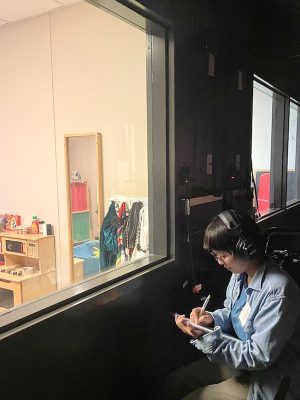
I develop and implement holistic wellness collegiate programming addressing alcohol and other drugs (AOD) and mental wellness, and I also co-facilitate educational workshops on substance use harm reduction.
This is not a completely new area for me. My first full-time job in Macau was at a residential setting for adults with substance use disorders, where I used expressive art therapeutic techniques to support their recovery. However, the Barnes Center provided me with valuable experience working in a higher education context with college students, and I found that their Integrated Health and Wellness Model deeply aligns with my person-centered approach.
Q: Where do you see yourself using these skills after graduation?
A: Aside from looking at job listings, I have been considering the possibility of a doctorate in counselor education and supervision down the road. That is a significant commitment, so I want to allow myself to explore more first.
If I go straight into work rather than further study, I would love to find a place that lets me practice CCPT directly. Getting my counseling degree puts me on a path to do mental health counseling work in the US, although licensure and the Registered Play Therapist credential are separate processes.
Since agencies specifically looking for play therapy experience often look for candidates who already hold both a license and the credential, I am committed to continuing my training and accumulating supervised hours now, so that I can work toward both as early as possible after graduation. The Charles Schaefer Play Therapy Scholarship has truly made this road more feasible for me.
If I cannot do CCPT right away, I would still like to find ways to incorporate play therapy into my broader practice, perhaps by building a play therapy room within an agency, while also continuing to work with a diverse range of populations across the lifespan. At minimum, I can use this scholarship to help fund the additional training and clinical supervision I need to keep working toward these goals.
Learn more about the M.S. in Clinical Mental Health Counseling or contact SOE Graduate Admissions.