
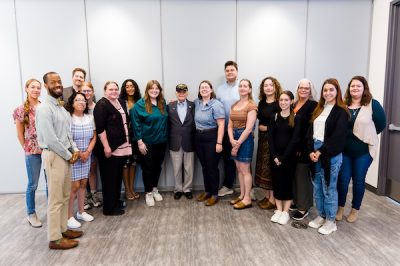
Now a credit-bearing course, EDU 400/600: Spector-Warren Fellowship for Holocaust Education is held every other year in January. It is a unique collaboration between the Holocaust Museum Houston and Syracuse University’s School of Education.
The Spector-Warren Fellowship addresses the challenges of future educators and others by equipping them with historical knowledge and effective practices for bringing developmentally appropriate Holocaust education to all learners.
Next Course: Jan. 4-11, 2026
“The Spector/Warren Fellowship has instilled in me that peace and justice can be achievable through the teaching of truthful, uncomfortable, and radically humanizing history, both inside and outside of the classroom. This experience showed me how non-traditional educators like myself can fill in gaps that our education system and policy leave open so that all of us can work towards a future free from atrocities.”
Binaka Norris ’23
“67% of educators currently teach about the Holocaust or would like to, but only 42% feel adequately prepared to do so.”
—Holocaust Education in Low-Income Classrooms, December 2021
Teaching about the Holocaust provides an opportunity to examine the basic moral issue of what it means to be a responsible citizen in a democratic society and provides an understanding of—and tools to disrupt—bias, discrimination, and hate.
Yet, many teachers, particularly pre-service teachers, express a lack of confidence and even fear when addressing the Holocaust, in part due to uncertainties about how to teach troubling history, handle difficult discussions, or anticipate student reactions.
Teachers need to know how to grapple with the teaching of complex and sensitive issues such as the Holocaust, navigating the need to cover required content while ensuring a safe classroom environment for all students.
Through the EDU 400/600, undergraduate and graduate students will:

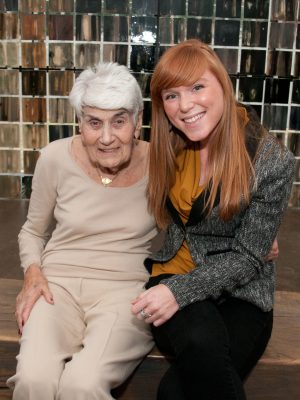
The Warren and Spector families established the Fellowship for Future Educators to honor Naomi Warren, by preparing future teachers with approaches for bringing Holocaust education into the classroom.
Naomi Warren overcame her own personal tragedy to become a symbol of perseverance, determination and success. Born in Eastern Poland, she survived three concentration camps during the Holocaust. Her first husband, Alexander Rosenbaum, died in Auschwitz in 1942, but Naomi survived the war and immigrated to the United States in 1946.
She married Holocaust survivor Martin Warren, and together the couple raised a family and established a successful import company. After her husband’s death, she continued to run the business until her retirement in 2002. She was awarded the Tolley Medal for Lifelong Learning by the School of Education in 2013.
Naomi passed away in October 2016. As our students go out into the world, they carry Naomi’s story, her spirit, and the meaning of being an ally to next generations.