When Chris Teodoro G’22 embarked on his Syracuse University journey after 24 years in the US Army, he discovered what many transitioning veterans already know: asking for help doesn’t come naturally.
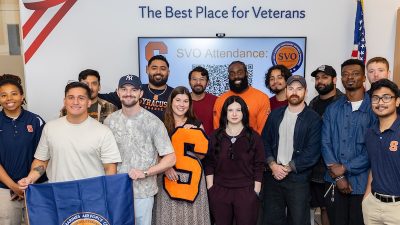
Thankfully, there’s a new program that provides customized support and explains the essential resources available to guide veterans and military-connected students on their journey to a college degree.
Now in its second year, the Office of Veterans and Military Affairs’ (OVMA) Resiliency Program (ORP)—a collaboration with Hendricks Chapel and the School of Social Work (housed in the School of Education)—represents a new model of integrative support for veterans and military-connected students transitioning from active duty to pursuing a degree.
“There’s this belief among veterans that they don’t need to ask for help and can figure out the issues they’re dealing with. But student veterans need to know they don’t have to go through this transition alone, that there are lots of us who have transitioned and are more than willing to give back,” says Teodoro, who is currently pursuing a doctorate of professional studies in information management from the School of Information Studies.
ORP staff employ a holistic perspective, combining academic, social, emotional, and spiritual skills to provide a model approach for supporting veterans and military-connected students.
“Our mission is addressing the unique stressors that veterans and military-connected students face in higher education while promoting their resiliency, their academic and personal successes, and the connectedness of our campus,” says Ken Marfilius, program director and Faculty Director of Online Programs and Strategic Initiatives in the School of Education. “We’re serving veterans in a comprehensive way.”
Targeting educational rather than clinical offerings, Marfilius says the ORP has helped connect veterans to housing and academic advising resources, developed impactful programs, built campus partnerships, and engaged with faculty and staff to raise awareness about the unique needs of student veterans.
VITAL Program Bridges Gap Between Military and Academic Life
One of the program’s early successes is the Veterans Integration to Academic Leadership (VITAL) program, a partnership with the Syracuse Veterans Affairs (VA) Medical Center’s Military to VA (M2VA) program.
Working with the Syracuse VA, veterans and military-connected students can receive direct access to mental health and wellness professionals while learning more about applicable VA programs and benefits, receiving advice and guidance as they transition from active duty into academic life.
“Transitioning from military service to civilian life can be overwhelming, and entering an academic environment adds another layer of complexity,” says Sonya Mangovski, Syracuse VA M2VA program manager. “VITAL bridges that gap, providing student veterans the support they need to thrive both academically and personally.”
“Our mission is addressing the unique stressors that veterans and military-connected students face in higher education while promoting their resiliency.”
Professor Ken Marfilius
During each semester, drop-in office hours for the VITAL program are held on the first floor of the National Veterans Resource Center at the Daniel and Gayle D’Aniello Building. Military-connected students can email the ORP for more information about upcoming office hours.
“This is valuable outreach and education, and we’re hoping to develop workshops and trainings around this effort,” Marfilius says. “This connection really strengthens the bridge between our campus and the VA, ensuring that no students fall through the cracks.”
Normalizing Help-Seeking Behaviors
The ORP gave Teodoro access to an academic advisor who knows first-hand what he’s going through: Marfilius, a US Air Force veteran who served as a mental health provider as an active-duty officer.
As Teodoro works toward his second degree—he also earned a master of business administration degree from the Whitman School of Management—he is focusing on how special operations veterans like himself can successfully navigate their transition from active duty to civilian life.
“The support from the military-connected community at Syracuse has been outstanding,” says Teodoro, who lives in Tampa Bay, FL. “I am involved in our military community here in Tampa and want to use the framework of my degree to make an impact for our transitioning veterans.”
By connecting the University’s academic departments with veterans’ services resources on campus and in the community, the ORP is providing a coordinated and informed approach while helping remove barriers to success for military-connected students.
“Making this program more visible and accessible helps us normalize help-seeking behaviors while building a stronger sense of community,” Marfilius says.
Originally published by SU News. By John Boccacino.