For Elyas Layachi ’27, a fall 2023 job posting on Handshake by Syracuse University School of Education (SOE) Professor Silvie Huang was serendipitous. Huang was looking for an undergraduate research assistant to help with an instructional design virtual reality (VR) project; he was a freshman engineering student interested in research and contemplating a transfer to SOE.
That posting became a catalyst for everything that followed. “I thought it would be a nice way to get involved in research and SOE,” Layachi recalls. Huang’s project proved an excellent introduction to science, technology, engineering, and mathematics (STEM) instruction for Layachi, who is now a junior taking Inclusive Adolescent Education and also studying for a Mathematics degree in the College of Arts and Sciences (a double major is an integral part of the adolescent education program).
Incredible Experience
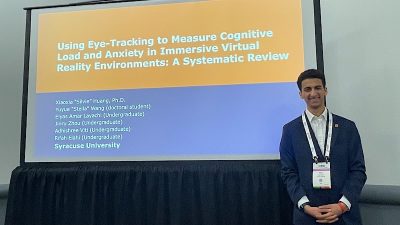
Funded through Syracuse University’s undergraduate research SOURCE initiative, Layachi collaborated with Huang to investigate how eye-tracking technology can measure a person’s cognitive load and anxiety in VR learning environments.
This work introduced Layachi to the intersection of technology and education, particularly VR’s potential to help mathematics students with visualization. Layachi and Huang are now preparing their findings—concluding that pupil diameter is a reliable cognitive load indicator and eye fixation duration a predominant metric to measure anxiety in VR users—for journal publication, a milestone he hopes to reach by the end of spring 2026.
“It’s very exciting,” says Layachi on the prospect of his first published scientific paper. His parents are both professors at St. John’s University: “I’ve wanted to follow in their footsteps. My goal was to just get my feet in the water with research, but SOURCE has led me to these opportunities. I’ve already presented the VR paper at the American Educational Research Association’s annual meeting. That was an incredible experience.”
Feeling Empowered
“My goal was to just get my feet in the water with research, but SOURCE has led me to these opportunities. I’ve already presented the VR paper at the American Educational Research Association’s annual meeting. That was an incredible experience.”
Layachi’s research portfolio expanded when Nicole Fonger, Associate Professor of Mathematics Education, introduced the Data Warriors to him during office hours in spring 2024. This after-school initiative empowers Syracuse City School District students at Nottingham and Henninger high schools to use statistical analysis as a tool for advocacy and social justice.
Currently, students are tackling projects on car theft rates, housing inflation, and lead poisoning, with this latter project resulting in data-informed letters to Syracuse’s mayor.
“The students aren’t just passively doing math; this content centers their experiences,” explains Layachi. “This way, students have autonomy and agency over what they learn, and ultimately better engagement leads to better learning.”
A summer 2025 SOURCE Bridge Award enabled Layachi to join Fonger’s Data Warriors team. Currently, he is reading students’ notes and preparing to conduct interviews as part of an analysis of the program’s impact: “The students report feeling empowered, with some saying they didn’t feel they were good at math before and are now more confident, enjoying the intersection between math and social justice.”
His goal with this scholarship is to develop a framework for culturally responsive statistical instruction. In other words, he’s taking a step toward implementing Data Warriors-like programs in other school districts.
Eye Opening
Both research projects have helped confirm what Layachi suspected during his freshman year leap of faith, transferring from engineering to education. “I was interested in engineering but not passionate about it,” he reflects. Now, he says that several student teaching placements—in the Solvay and Syracuse school districts—have been “very eye opening,” solidifying his preference for upper middle or high school teaching.
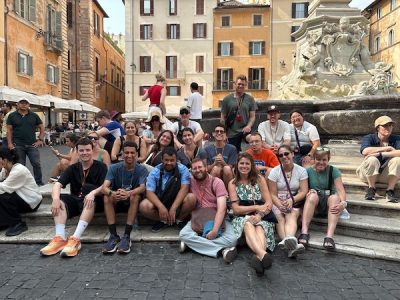
To deepen his understanding of inclusive education and his future profession, in summer 2025 Layachi joined other matriculated students, as well as InclusiveU students, on SOE’s first ever inclusive study away trip to Italy, to engage with that nation’s long history of integrating students with disabilities into their public school system.
In Rome, Layachi not only met principal Simona D’Alessio, he is in the process of creating a research project with D’Alessio’s help, exploring inclusive mathematics education both in the city of Syracuse and in Rome.
For prospective students considering undergraduate research, Layachi’s advice is straightforward: “Seek out research opportunities on Handshake, and get to know your professors. Look into SOURCE; a Bridge Award like the one I received can help get you on a research team. Also, look outside your discipline; I was open to many kinds of research.”
That openness transformed an uncertain engineering student into a confident educator/researcher in training, presenting to a national conference of scholars and preparing his first published paper while still an undergraduate.
Learn more about the B.S. in Inclusive Adolescent Education, or contact Heather Macknik, Assistant Director of Undergraduate Admissions, at soeadmissions@syr.edu.