
In the Reflections series, the School of Education asks alumni to look back on their distinguished and fascinating lives and careers.
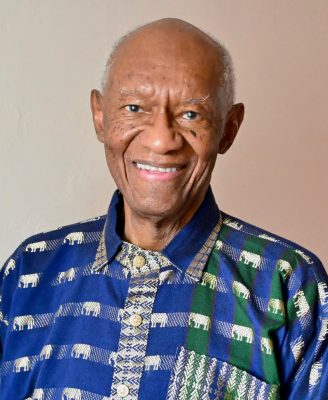 Teacher, professor, author, actor, and artist Walter Gill G’71, G’77 was born in Greenville, MS, and received his early schooling in Jefferson City, MO, and Baltimore, MD. He was the first African American to graduate from Baltimore City College High School, the third oldest high school in the country. He received his undergraduate degree from Morgan State University (1960), and he holds both a master’s and doctorate from Syracuse University School of Education.
As an art teacher, Gill developed the Art-Socio Diversity Program for incarcerated youth at the Waxter Detention Center in Laurel, MD, producing art exhibitions for the program in the Baltimore area. Three decades later, he taught the same program to incarcerated youth at Maryland’s Charles H. Hickey Jr. School and Woodbourne Center. The Baltimore Sun and Maryland Public Television’s State of the Arts were among the media outlets that documented his teaching at the Hickey School.
In higher education, Gill was an administrator at Bowie State University and was the first professor hired for the Telecommunications Program, now the School of World Journalism and Communications, at Morgan State University. He also taught in the University of Nebraska at Omaha’s (UNO) Goodrich Program, Black Studies Department, and College of Education.
Gill won Nebraska Committee for the Humanities funding for “The Black Frontier Film Series,” a four-week program for the Great Plains Black Museum, and for “Black Independent Films,” a three-week program for the Black Studies Department at UNO.
As an author, Gill’s column—“Up Through Education”—was featured in the Omaha Star, and he has written three books on urban education. As an actor, he won Best Supporting Actor Award in Purlie at Center Stage (Omaha) and Best Actor Award in The Boys Next Door at The Omaha Community Playhouse. As an artist, he designed and copyrighted the “I Love Baltimore: The Harbor City” T-shirt.
Gill is closely associated with the Malcolm X Foundation (Omaha, NE, is the birthplace of Malcom X), and he sponsored a Belle of Brownsville riverboat cruise to raise money for the foundation.
In other service posts, Gill was appointed by various governors of the state of Maryland to the Citizens Review Board for Children in Foster Care and as a commissioner to the Maryland Commission on African American History and Culture, the oldest ethnic commission in the country. In July 2025, he was reappointed to a second four-year term on MCAAHC. In October 2025, he was the guest speaker at Morgan State University’s Fine and Performing Arts Convocation.
“He or she who teaches learns about teaching.”
What is your fondest memory from your time at Syracuse University/School of Education?
At Syracuse University, I found six pillars responsible for my professional success. Dr. Kenneth Fishell, my key advisor, said, “Walter you are already using art to enhance the self-concept of your students. All you have to do is put some statistics to it for your doctorate.”
The others were: Dr. Wesley McJulian, then a doctoral student and my mentor and the first African American president of the Association for Educational Technology and Communications; filmmakers Dr. F. Lee McConkey and Dr. Jack Tyo; instructional design and technology professor Dr. Donald F. Ely; and Alif Muhammad, of the Syracuse Eight, for a lifetime of friendship.
What is something from your career that you are most proud about?
Teaching art in various communities, which has included the Salt Springs Projects of the Syracuse Boys Club; Koinonia Baptist Church’s after school program, Living Classroom Summer Program, and Paul Robeson Academic International School of Excellence Weekend School (all in Baltimore); and the Mercy County Detention State Incentive Program in New Jersey.
Over the years, 16 calendars have been produced consisting of student artwork and photography, and included federal and religious holiday, artists’ birthdays, and African American male role models.
What is the biggest change you have seen in education in your lifetime?
Although Brown vs. Board of Education, of which I benefited, was significant, none has been as impactful as technology. Technology has affected how students learn, teaching modalities, online classrooms, home schooling, and is affecting the mental health of students—and not always in a healthy direction.
What gives you hope for the future of education/teaching?
My hope is that many of the present federal policies for education are an anomaly; K-12 will continue to adapt in order to effectively teach all socio-economic groups; colleges of education will train all pre- and elementary school teachers to be reading specialists; and educators can do what they know is best for students without outside interference.
What advice do you have for an SOE student just starting on their career path?
As a teacher, always maintain humanity in the teaching process, especially with younger students. Incorporate reading of the printed page from pre-K to high school. Take courses, workshops, and attend events that will prick your curiosity and challenge your comfort level: “He or she who teaches learns about teaching.”