
As a freshman, Mason Burley ’27 made himself a promise: experience as much of the world as possible and “put myself out there.” In fact, his first trip over the Atlantic was a study abroad experience in Kenya. And he’s been racking up the miles ever since.
“I guess I did put myself out there,” he observes.
Since arriving at Syracuse, the Inclusive Adolescent Education and History double major, Disability Studies minor, and recently-named Remembrance Scholar and 2027 Class Marshall, has logged study away experiences on four continents—playing soccer with village kids in Kenya, bartering at a Maasai market, teaching at a private school in Poland, standing at the Brandenburg Gate, and meeting a Holocaust survivor.
But Burley isn’t collecting passport stamps for the sake of it. Every trip ties back to the classroom he will soon be leading. “These experiences have helped solidify my decision to be a social studies teacher,” he says. “I wouldn’t be the educator I am without them.”
Burley understands that cost is a reason some students might not do study abroad or study away. But his own journey was made possible by a mix of support available to others: the Corinne R. Smith Study Abroad Program Fund, the Spector/Warren Fellowship, a gift by Lauri ’77 and Jeffrey Zell ’77, and Syracuse University Abroad. “Don’t be discouraged by cost,” he says. “There are many opportunities for financial help.”
Even though you might only make one study trip, Burley’s story is proof that trip can change everything. We take a tour around the world with him as he describes some of the photographic memories recorded along the way.
Summer 2024: Kenya
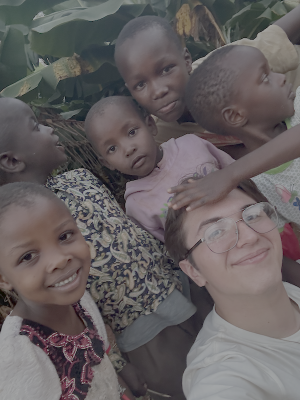
During our study abroad trip to Kenya, we were based in a homestay in the village of Ugweri. This photo was taken when we were heading out for dinner. We met some village kids and played soccer with them. I remember they were fascinated by my hair as they had never met someone with straight hair before.
This Kenya study abroad program is organized by School of Education (SOE) professors Joanna Masingila and Jeffrey Mangram. It enables pre-service teachers to experiencing rural and urban education in the nation and interact with students, teachers, and university faculty.
A major difference I saw with Kenyan education is that the government picks your major based on the state’s needs. Also, the education system is a British colonial holdover. The lessons were very western-centric education, with not much about native history.
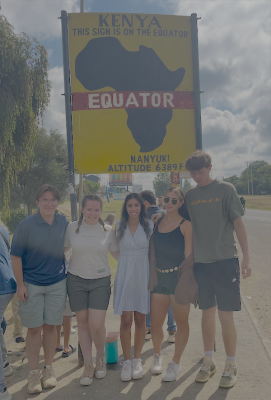
This photo shows some of my cohort at Nanyuki, a small village on the Equator that is a big tourist destination even for Africans. My cohort was a mix of undergraduates, graduate students, and doctoral students. All were from the School of Education except for one.
One of the most interesting places I visited in Kenya was a Maasai market. There were hundreds of vendors, and we got to barter with them. It was good to experience these local customs, and I became quite well known for bartering!
Spring Break 2025: Washington DC
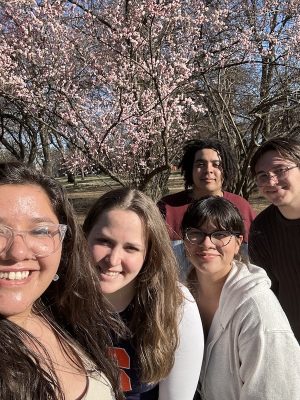
During Spring Break, SOE Professor Julia White offers EDU 400: Atrocity Studies and Human Rights, a credit-bearing immersion week in Washington, DC. This group was mostly undergraduates from SOE and the Maxwell School of Citizenship and Public Affairs. We met with human rights activist groups, visited organization such as the US Institute of Peace, and toured the Holocaust Museum.
As a history teacher, I am interested in teaching the Holocaust and in learning how to bring the new era of policies and activism into this work because human rights abuses are ongoing.
This photo is of almost the whole of the DC immersion week cohort. We were visiting the world war memorials near the National Mall when we took this selfie next to one of the famous cherry blossom trees. It was a very good cherry blossom day.
Fall 2025: Central Europe (Czechia, Germany, Moldova, Poland, and Romania)
In 2025, I was awarded a Tyler Center for Global Studies Fellowship, which is a grant made to 12 universities by Florida State University and distributed at Syracuse by SOURCE. As part of this grant, I am working on a research paper about Soviet era education programs, how they affected Soviet bloc children, and how they were used to spread propaganda.
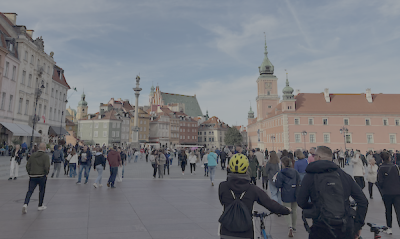
This photo was taken in Warsaw Old Town, which was rebuilt after the bombing of World War 2, using old paintings as references. We spent between three and five days in each country and traveled by bus. We visited museums and other cultural and historical sites, including the Nazi camps Auschwitz and Treblinka, and took classes at Poland’s University of Lower Silesia.
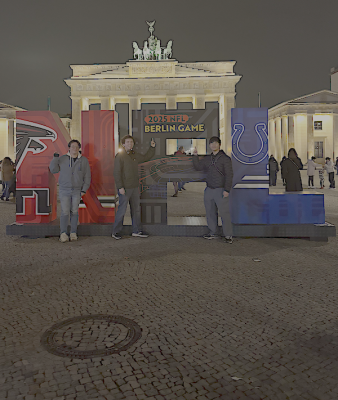
This photo shows the famous Brandenburg gate in Berlin. There was an NFL game being played in the city between the Atlanta Falcons and Indianapolis Colts. That was a crazy clash between German and American culture!
Berlin was my favorite of all the places we visited. It had both old and newer history, and I was especially struck by the contrast between East and West Berlin, the differences in public transportation and the contrast between the old halogen lights in the East and the new LED lights in West Berlin. As a history teacher, those disparities gave me food for thought.
January 2026: Houston, TX
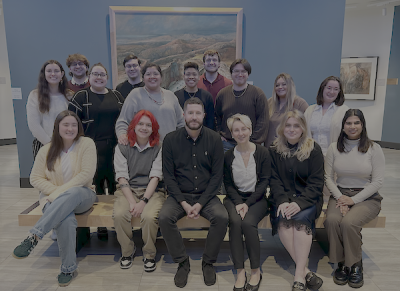
Another short-term study away course SOE offers is the Spector/Warren Fellowship for Holocaust and Human Rights Education, which you can take for credit with Professor Emerita Rachel Brown. This program is geared more toward Holocaust educators, so there were social studies education students on this trip, as well as some museum and library studies students.
The cohort traveled to the Holocaust museum in Houston, TX, to learn how to properly teach about the Holocaust and human rights. There are lectures, and we even met a Holocaust survivor, Bill Orlin, who is a local legend. He is in his 90s, but he is still sharp as a tack, digging back dozens of years. He was a lovely gentleman to talk to, and he made us understand the importance of individual stories when learning about the Holocaust.
Learn more about the School of Education’s experiential learning opportunities, including study abroad and study away.