
Do you consider yourself “math phobic?” If so, Eugenia Cheng’s upcoming Syracuse University concert and lecture might be the best “exposure therapy” you can get.
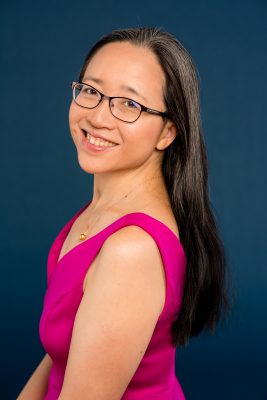 Cheng brings her popular mix of mathematics and music to Hendricks Chapel on Thursday, Oct. 9, 2025, as part of her mission to rid the world of math phobia. “The Logic of Creativity: Music, Mathematics, and Expression” starts at 4 p.m. It is free and open to the public and a reception follows. Cheng’s books also will be on sale. For more information, visit the Syracuse University events calendar.
Currently the Scientist in Residence at the School of the Art Institute of Chicago, Cheng teaches at the University of Sheffield and City University of London in the UK. Beyond her teaching, she is widely known as a multi-talented mathematician, author, public speaker, columnist, concert pianist, composer, artist, and chef.
Cheng’s YouTube videos, including for The Royal Institution, have 15 million views and counting. Her first popular book How to Bake Pi (Basic, 2015)—an “edible exploration” of mathematics and cooking—led to acclaim from The New York Times, National Geographic, and Scientific American. Cheng has been interviewed on the BBC, NPR, and The Late Show with Stephen Colbert. She also writes the “Everyday Math” column for the Wall Street Journal and is a featured TEDx London presenter.
Other books include Beyond Infinity (Profile, 2017); The Art of Logic (Basic, 2018); x+y: A Mathematician’s Manifesto for Rethinking Gender (Basic, 2020); The Joy of Abstraction (Cambridge, 2022); and Is Maths Real? (Basic, 2023). She has written two children’s books: Molly and the Mathematical Mysteries (Big Picture, 2021) and Bake Infinite Pie with x+y (Little, Brown, 2022).
“The Logic of Creativity” is a 2025-2026 Syracuse Symposium event, presented by the Syracuse University School of Education’s Harry S. and Elva K. Ganders Memorial Fund Lecture Series and co-sponsored by Syracuse University Humanities Center, Historical Keyboarding Working Group of the CNY Humanities Corridor, Setnor School of Music, and The Study Council.