
Syracuse University School of Education (SOE) doctoral candidate Atiya McGhee has been awarded a prestigious American Association of University Women (AAUW) Dissertation Fellowship for the 2025-2026 academic year.
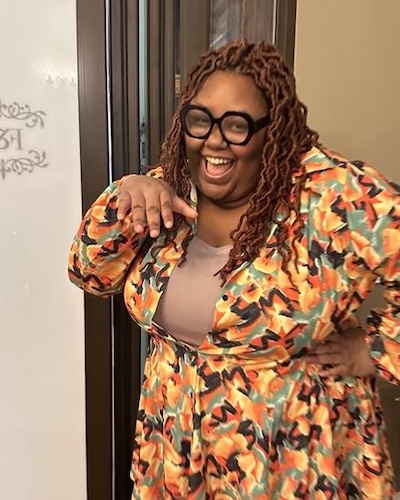
McGhee adds this accolade to their SOE Research and Creative grant (2022) and Joan Burstyn Endowed Fund for Collaborative Research in Education award (2023); University Pre-Dissertation Summer Research Fellowship award (2023); and College of Arts and Sciences Joan Lukas Rothenberg Graduate Service Award (2025).
Before coming to Syracuse, McGhee received a B.A. in Creative Writing and Literature from Wheaton College in Norton, MA (2014), and an M.Ed. in Higher Education and Student Affairs Administration from the University of Vermont (2016). In addition to their Ph.D. studies, they are currently pursuing a Certificate of Advanced Study in Women’s and Gender Studies. They hold a Future Professoriate Program Certificate in University Teaching from Syracuse University (2024).
McGhee is a community facilitator committed to dialogic pedagogies around topics such as race, gender, sexuality, and (dis)ability.
Supported by the Burstyn Fund and the University’s Intergroup Dialogue Program (IGD), McGhee—alongside Linzy Andre G’25 (Counseling and Counselor Education) and professors Michael Gill and Gretchen Lopez—led a fall 2023 dialogue titled “Politics of the Body: A Dialogue on Fatness and Body Size,” which explored topics related to fatphobia and its connection to other systems of oppression. Their experience co-leading this dialogue deeply influenced their dissertation topic.
McGhee also notes the importance of their experience as a graduate assistant with the Democratizing Knowledge Collective and as a teaching assistant for the Department of Women’s and Gender Studies—especially the “rich mentorship with the research process and critical community.”
About Atiya McGhee’s Doctoral Thesis
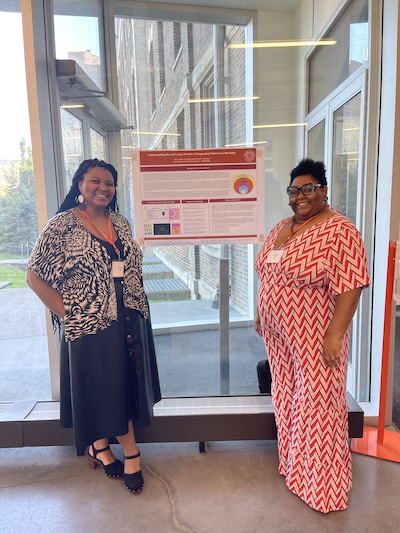
Tentatively titled “‘Eating the Other’ to Produce the ‘Fit Citizen:’ Readings of Black/Fat/Crip Women’s Mediations and Resistance to Whiteness’ Insatiable Appetite for Blackness” explores how multiple infrastructures across time work together to configure Black/Fat1/Crip2 women as always out of bounds to health.
This research contends with the intraracial politics of respectability (attitudes and beliefs about fatness, disability, and health) in the Black community; how large, super, infinite, and death fat3 Black women grapple with a world in which many “accessible” things are out of bounds because of their corporality: their size4; and how Black/fat/crip women find joy in their blackness, fatness, and ability status.
Threaded through their dissertation is also the anxious calculation of life, death, productivity/leisure, and of value. These anxieties accompany surveillance and public shame to keep the body disciplined and those unfit rooted back to the private.
Notes
- Within fat studies, fat is a neutral descriptor of the body. It is an act of reclamation. Fat study scholars generally avoid the words obese and overweight given that both are derived from a medical model that considers these bodies to be abnormal, excessive, and in need of correction. See Audrey Gordon’s book, What We Don’t Talk About When We Talk About Fat (Beacon Press, 2020).
- I utilized the term crip in alignment with other feminist, queer, and crip/disability theorists such as Robert McRuer, Alison Kafer, Sami Schalk, and Theri Pickens. I owe my initial awakening to the possibilities of Black/Fat/Crip theorizing to Sami Schalk’s article “Coming to Claim Crip: Disidentification with/in Disability Studies.”
- I draw my definitions of large, super, infinite, and death fat from the work of Fluffy Kitten Party.
- While some fat scholars utilize the language of phat, thicc, thick, and other variations to discuss fatness as it pertains to the fat body, I am weary of using this language, even as it is developed by those within the Black community, because it is informed by shapism and does have limitations regarding the size to whom can claim the term. See also Da’Shaun Harrison’s critique of the term in their blog. This does not mean I believe we should not use thicc/thick, phat, and other variations—they have their place. At this time, I have decided not to use this language for my dissertation research.