
Syracuse University students turned lived experience, empathy, and emerging technology into innovative and inclusive disability solutions at the Intelligence++ Innovation Showcase, hosted at Syracuse University’s Bird Library on Dec. 9, 2025.
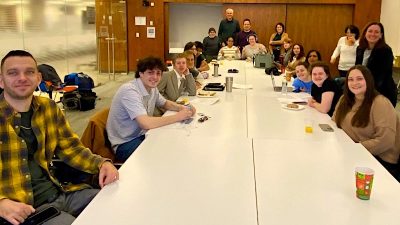
The event marked the culmination of a semester-long interdisciplinary design course offered through the School of Education’s Taishoff Center for Inclusive Higher Education InclusiveU program, the College of Visual and Performing Arts School of Design and Syracuse University Libraries.
The program is open to all undergraduate and graduate students across the University, including students with intellectual disability. Students partner to create accessible products and services with real-world impact, giving neurodivergent innovators a place to lead and offering all students the opportunity to design with people with disabilities rather than for them.
The program, funded through a gift from the Foundation for Augmented Intelligence, is built on a philosophy that people with disabilities bring unique insights that can drive market-changing ideas. It encourages teams to learn universal design principles, conduct deep user research, learn the basic principles of entrepreneurship, and deliver functional prototypes and pitch presentations by semester’s end.
Four student teams presented solutions to challenges that people with disabilities face in daily life. From safe food testing to accessible meal planning, grocery shopping and school safety, the projects highlighted both creativity and compassion and received enthusiastic feedback from judges across business, accessibility and technology sectors.
Detecting Dairy Allergens: Zero React
Zero React demonstrated how a simple tool could remove fear from eating. Inspired by team family members who suffered from severe and undiagnosed allergies, the six-person team created a portable allergy test strip designed to detect dairy proteins, particularly milk and casein, in foods.
The test works similarly to the now-familiar COVID rapid tests. A user dips the strip into a small sample of food and applies a solution. Within a minute, clear lines appear indicating a positive or negative result. The students built their initial prototype using 3D modeling software and the MakerSpace at Marshall Square Mall 3D printing environment. They also went beyond proof-of-concept to produce a full brand system, a user manual with step-by-step illustrated instructions, and a market launch plan.
Their discovery phase engaged allergy patients, parents, nurse practitioners, chemistry faculty, and national allergy communities. The team also conducted secondary research into existing test-strip technology and FDA regulations.
User personas helped the team to define their target customer, mothers of children with dairy allergies who are frustrated with unclear labels, inconsistent regulation, and the constant fear of cross-contamination. Zero React sees multiple sales channels, from pharmacies to stores to allergists’ offices, with a plan to leverage short-form social content and parent influencers to accelerate awareness.
Accessibility was also prioritized. The strip is designed to be easy to hold, easy to use, and easy to interpret for users with vision or cognitive disabilities.
Judges praised the team for the sophistication of its research and business strategy. “This blows my mind,” one judge said. “It’s an obvious need with a very strong product-market fit.” With strong early traction and a clear market path, the team says it hopes to evolve the prototype into a product ready for regulatory review and eventually grocery-store shelves.
Making Meal Planning Easier: Accessible Appetite
Accessible Appetite is a three-person team tackling a daily challenge for millions: planning a meal when executive functioning and decision-making are overwhelming. For people who are neurodivergent or who struggle with sensory processing, the sequencing of meal prep, including time, steps, budget, and nutrition, can be exhausting.
The team shared that after long days of work or school, friends told them they felt defeated by food planning, despite wanting healthy options. Meanwhile, existing meal-prep apps focus on only one piece of the puzzle such as recipes, shopping lists, or nutritional tools, but none integrate them in a connected, easy-to-navigate way.
Accessible Appetite’s solution is a web and mobile platform that streamlines the entire planning experience with four core inclusive features:
- Smart Plate Builder: Calculates nutrition automatically and visually, which is ideal for users who struggle with portioning or nutrient tracking.
- Smart Substitutions: Swaps out ingredients that cause sensory discomfort (e.g., texture, smell, temperature).
- Allergy-Aware Options: Automatically identifies substitutions for food allergens.
- Smart Search + Machine Learning: Learns personal dietary needs and preferences over time, making recipe discovery less overwhelming.
The team also incorporated a chatbot, allowing users to ask clarifying questions during the cooking process, a major support for those who expressed the need for step-by-step guidance.
Wireframes and visual branding emphasized accessibility first, with no distracting pop-ups, minimal clutter, high contrast options, and clear visual communication for users who learn best by seeing the path ahead.
Judges called the pitch “relatable and promising.” Many confessed that even without a diagnosis, meal planning is a common source of stress. They applauded the focus on visual learners and the user-centered research that drove the design. If successful, the team and judges believe the app could convert an intimidating chore into a more empowering and enjoyable experience.
Navigating Grocery Stores with Calm: Ease Cart
For their project, the two-person team behind Ease Cart asked a simple question: “What if grocery shopping didn’t have to feel like chaos?”
Bright lights. Aisles clogged with carts. Noise. Crowds. Constant movement. Price displays that are hard to find or read. For people with sensory processing disorders, this weekly errand can be debilitating. Many do not disclose their struggles, and few stores offer solutions that meaningfully reduce sensory overload.
Ease Cart conducted interviews with students who avoid stores entirely because of stress, as well as with shoppers who trialed other store-specific accessibility services. A common thread emerged that any successful tool must be both affordable and accessible, not an expensive add-on or special request at the counter.
So, they created a calming smart store-mapping app. The tool uses soothing colors, notably lavender, selected because of its sensory-friendly nature, and clear navigation to help users locate items efficiently and minimize time spent in high-stress environments.
The wireframes included:
- A sensory-friendly display mode using soft hues and minimal visual noise.
- Audio read-aloud features for users with visual impairments or attention challenges.
- Budget alerts and receipt organization.
- Templates for fast grocery-list creation.
Judges applauded the team’s insight that crowded, confusing stores are a universal frustration. While designed for the sensory-sensitive community, they noted, “This could help anyone.” The team’s next step is to build a functional prototype and conduct UX/UI testing with diverse shoppers.
Phones for Emergencies Only: Every Second Counts
Every Second Counts focused on a fast-emerging issue in K–12 education, which is the growing number of US schools banning cell phones during the school day, including a new mandate in New York State.
The policy aims to limit distraction from social media and gaming apps in classrooms. But it has sparked a critical question: How do students call for help in an emergency if their phone is locked away?
Over the last decade, students have faced crises while in school, from medical emergencies to safety threats, and urgent personal situations that require immediate communication. Every Second Counts argues that removing phones entirely removes safety itself.
The team researched policy and public opinion and interviewed teachers, students, administrators, and parents. They also studied other states, including pilot programs in Massachusetts, where schools are testing ways to block entertainment while preserving emergency access.
Their solution: a VPN-based emergency-only mode triggered automatically when a student walks into school and connects to campus Wi-Fi. Gaming and social apps disappear, and an emergency app appears, giving students one-tap access to help if danger arises.
Jeff Rubin, Syracuse University’s Senior Vice President for Digital Transformation and Chief Digital Officer, and a high school parent, offered the team technical advice to help them explore comparable deployment platforms.
With strong validation and a growing need, the team plans to continue development in the spring with technology experts. Judges were extremely impressed by the commanding research that went into the many dimensions of the problem and the firm grasp on what a technology development roadmap might look like. They encouraged the team to keep working on this through the spring semester, recognizing its potential.
Inclusion and Impact
Throughout the showcase, judges emphasized how impressed they were by the depth of research, the thoughtful branding and design work, and the professional quality of each pitch. Students interviewed dozens of users, and several teams planned go-to-market strategies that could move forward credibly.
“That is exactly the vision of Intelligence++,” says Gianfranco Zaccai VPA ’70, H’09, who founded and funded the program at Syracuse. “It is designed to empower students to design together, while exploring entrepreneurship as a tool for inclusion.”
Zaccai continues, “The program invites students from engineering, design, business, communications and the arts to collaborate, as it partners with stakeholders and community organizations to ensure that lived experience leads the process. Students learn how rigorous discovery leads to better products and how accessible design helps everyone.”
By Linda Dickerson Hartsock, Strategic Initiatives Advisor, Syracuse University Libraries