Mr. Smithers is the concerned parent—portrayed by professional actors—at the center of a challenged book clinical simulation designed for student teachers by the Center for Experiential Pedagogy and Practice in the Syracuse University School of Education (SOE).
 This simulation is one of the events planned for Banned Books Week 2025—from October 6 through 10—organized by Syracuse University Libraries, in collaboration with SOE; the College of Arts and Sciences’ departments of English, Religion, and Women’s and Gender Studies; and the S.I. Newhouse School of Public Communications.
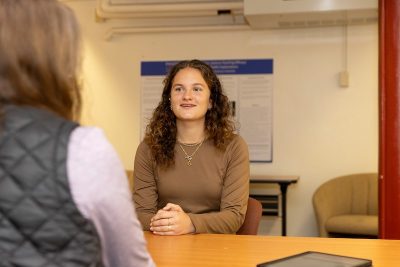
In the Smithers simulation—which can be observed as a live demonstration on Wednesday, October 8 from noon to 1 p.m. in the Simulation Laboratory on the fourth floor of Huntington Hall—an actor will portray the proud parent of “Allison,” an honor roll student and aspiring nurse.
The challenged book is Siddhartha by Herman Hesse, which Mr. Smithers objects to because of its references to female body parts and prostitution. An SOE student—portraying a 10th grade English teacher—will discuss the objection with the actor/parent, who has asked that the class, or at least his daughter, be given an alternative text.
The goal of introducing student teachers to this tricky scenario in a safe, controlled environment is so they can learn skills and strategies to manage, including how to read body language, recognize overly aggressive argument, maintain authority and professionalism, keep cool under pressure, and communicate effectively.
Moreover, the student teachers can practice how to empathize with a parent and understand when natural concern for their child is valid.
Also featured during Banned Books Week will be SOE doctoral candidate Teukie Martin. Martin will lead the Banned Book Teach-In, along with the student group Beyond the Book, on Wednesday, October 8, from 2 to 3 p.m. in the Peter Graham Scholarly Commons in Bird Library.
Participants can explore the history and politics behind the current wave of book bans and challenges, the mechanisms through which censorship occurs, and how we can resist as scholars, educators, and community members.