
Motivation, persistence, dedication, ambition. These are some of the skills that have propelled Maximiliano Jimenez G’25 toward a burgeoning career in student affairs and higher education administration.
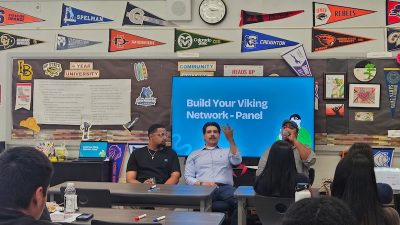
Now, thanks to a high school-to-college success program developed as a Syracuse University School of Education (SOE) master’s degree student, Jimenez is giving back to his community by passing along some of the expertise, experience, and knowledge he gained in his master’s degree program.
The Viking Network—named for his former high school’s mascot—is a collaboration among school staff and alumni to help low-income, first-generation students persist through high school and college.
Taking part in the August 6 event were 20 students and 3 alumni of James Monroe High School in North Hills, CA, a northern suburb of Los Angeles. Given the positive reviews of this inaugural Viking Network, Jimenez says he hopes not only to continue the program in his hometown but expand its reach, including to Syracuse-area schools.
“I applaud and am inspired by Max’s passion, leadership, determination, and resourcefulness to take a project generated in a class into such impactful program back in his high school community,” says Professor Cathy Engstrom, SOE Faculty Director for Graduate Studies. “While the seeds for this creative initiative germinated in one class, it is exciting to see the project develop, reflecting knowledge and skills he gained across many courses he took in his Higher/Postsecondary Education master’s degree program.”
Finding Solutions
As a graduate assistant, Jimenez worked for the WellsLink Leadership Program, an academic excellence initiative for first generation students at Syracuse University. He sees the Viking Network as widening the scope of this kind of support. “Why not move the intervention point away from individuals in the first year of college to high schoolers in their final year?” Jimenez asks. “All high school students could benefit from this program.”
“Why not move the intervention point away from individuals in the first year of college to high schoolers in their final year?”
In school and then at the University of California at Santa Barbara (UCSB), Jimenez took a law and policy path, a way to explore why poverty and economic and social challenges persist in his northern LA community. Like some of his close high school friends, he was motivated to leave North Hills to further his career, but always with an eye on supporting his community someday.
In his junior year at UCSB, Jimenez pivoted toward a higher education career, finding that he enjoyed his work as a resident assistant and in other student life positions: “I thought a higher education career would enable me to keep the same goals of helping my community and of finding solutions to educational and economic challenges that I saw and experienced.”
Turning his work ethic and persistence toward this new challenge, Jimenez was soon asking resident directors about their career paths. As it happened, two of those colleagues were Brandon Langford G’21 and Nicholas Lee G’21, both Higher/Postsecondary Education graduates happy to write letters of recommendation for him.
More Than Capable
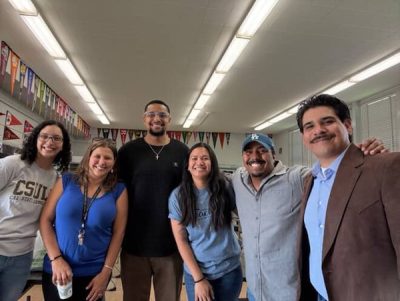
The idea for the Viking Network was developed early in Jimenez’s graduate school career. “In the Introduction to the College Student course, we were asked by Professor Cathy Engstrom to do a College Equity and Success project: conceive of a program to enhance students’ college access and belonging,” he explains. “I was thinking of a project to help communities like mine break cycles of poverty and under-development.”
His first idea—a mentorship program—was a popular idea when he pitched it to his high school, but although they were on board, Jimenez put its development on hold as he finished his master’s degree. By the time he graduated in spring 2025, he had joined the board of the James Monroe Alumni Scholarship Fund, was slated to become the new Program Coordinator of Syracuse University’s SENSES Project, and was ready to return to the Viking Network: “It was still something to accomplish after graduation.”
Now conceived as a college preparation symposium, planning with his high school began in June 2025: “We settled on a one-day event structured like a typical high school day, with 50-minute seminars on applying for college, writing the Personal Statement, networking, and ‘perception and persistence,’ as well as an alumni panel.”
School counselors led some sessions, with Jimenez taking networking, perception and persistence, and the alumni panel. “Simple skills and tips were the bread and butter of how I reached success,” observes Jimenez, pointing out that sometimes high school students don’t realize they have the skills to succeed in higher education.
“I never thought I would get a chance to actually implement the program that I turned in for an assignment.”
A game of “Networking Bingo” helped proved that point. Jimenez recalls that when he asked students in the networking session what that word meant, no hands were raised. He then had them interview each other to learn more about their lives (and fill in their bingo card), which they excelled at. That is, they had proven to themselves that they indeed know how to ask questions and discover useful information. “They are more than capable, but they are not always aware that they are,” notes Jimenez.
Something Coveted
“It’s hard for students to see how useful some skills are until they get to college,” Jimenez continues. He explains that one of the foundational theories for the Viking Network is Tara Yosso’s concept of “community cultural wealth,” the idea that all students bring with them forms of capital that can be leveraged for success.
These forms include “aspirational capital,” or a student’s limited/unlimited capacity to aspire to great things; “navigational capital,” or a student’s ability to interact with complex institutions; and “social capital,” a student’s social network, including supportive friends. Jimenez says his high school pals are now a network that has graduated top colleges and launched successful careers: “Having that friendship group sling-shotted me past my own expectations for myself.”
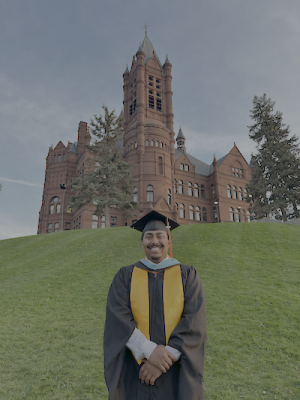
Through the Viking Network, Jimenez also wants to address one of the negative cultural realities he experienced as an ambitious high schooler. “I was criticized for ‘acting white’ when I aspired to academic success,” he explains. “This attitude is sometimes connected to ‘oppositional cultural theory.’ It means that when students of color see academic achievement as something they don’t have access to or of a different culture, they disassociate themselves from it. Our alumni panel addressed this, letting the students see that academic achievement can be a part of their culture as well.”
If Jimenez’s post-symposium survey data is any indication, the event was a hit with his fellow Vikings. After the session on networking, a majority agreed that they felt more confident reaching out to professionals and understood how networking can help them get ahead (the game “Networking Bingo” was also a big hit.) The perception and persistence seminar also boosted the students’ confidence in ancillary academic skills, including time management, goal setting, taking care of mental health, and asking for help.
“I never thought I would get a chance to actually implement the program that I turned in for an assignment,” says Jimenez, adding “I will continue this work till I die! I want to build this program into something that is coveted. I might even pursue it as a doctorate.”
In the meantime, Jimenez is concentrating on building the SENSES Project, which encourages students to work on their music and podcast passions in the Steele Hall 001 studio.
“At SENSES, I want to create a culture that feels like home, drop more albums, and collaborate with the community at large,” says Jimenez, an a cappella signer with Otto Tunes. “I’m excited for those snowy afternoons, when students drop in after class and create community. That’s when I feel I’m really part of this space.”
Learn more about the master’s degree in Higher/Postsecondary Education, or email soeadmissions@syr.edu.