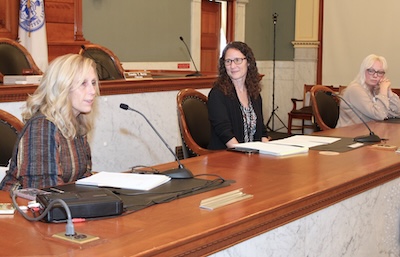
On a mid-October morning, the stately chambers of the Onondaga County Legislature were filled with students and faculty from Syracuse University’s School of Social Work mingling with lawmakers and community leaders.
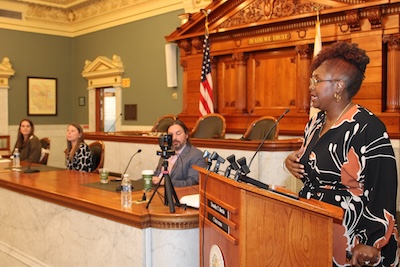
They were gathered for the James L. Stone Legislative Policy Day, an annual event founded 26 years ago by Professor Emeritus James L. Stone ’64, former New York State Commissioner of Mental Health, who sought to give social work students the opportunity to connect with the policymakers shaping the systems that affect their field.
The 2025 event, co-sponsored by the School of Education (which houses the School of Social Work), brought together expertise and insight around the theme, “Undermining Youth Potential: The Hidden Costs of Disinvestment in Educational Support Structures and Services.” The focus was inspired by recent federal funding cuts and mandated changes affecting a wide range of social service systems.
View the Photo AlbumCollective Commitment
“Legislation is more than words on paper,” said Associate Teaching Professor Joseph L. Smith G’91 in his opening remarks. “It reflects our collective commitment to justice, equity, and opportunity.”
Smith reminded the audience that social workers are often the link between policy decisions and the communities those decisions affect. “This day is about education, collaboration, and action,” he said. “It’s about making sure our voices are heard and that policymakers understand their decisions matter.”
Following introductions from Associate Dean Jing Lei, Director of Social Work Yvonne Smith, and Onondaga County Legislature Chair Timothy Burtis, students presented an overview of the recent and dramatic changes in policy and funding that framed the day’s agenda. Their presentation highlighted the potential consequences of these cuts—from staff reductions and fewer mental health services to the loss of after-school and enrichment programs that support students’ well-being and development.
“Legislation is more than words on paper. It reflects our collective commitment to justice, equity, and opportunity.”
Associate Teaching Professor Joseph L. Smith G’91
Assemblyman William Magnarelli (D-129) followed with a detailed breakdown of where the rollbacks would take effect across New York State and their anticipated impact on families. He emphasized the cascading and intersecting implications of cuts to mental health initiatives—many of which were created in response to school shootings—along with before- and after-school programs that are vital not only for students but also for working parents. He also cited cuts to food assistance programs such as SNAP and health care programs for uninsured and immigrant populations.
People and Relationships
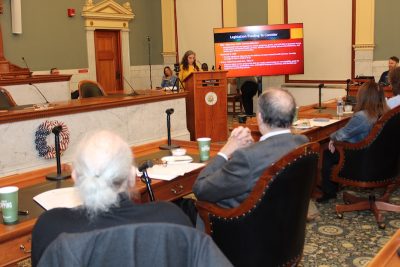
The day’s keynote speaker, Rachael Gazdick ’93, former Executive Director of Say Yes to Education Syracuse and current CEO of NY Edge, drew on her experience leading one of the largest after-school providers in New York City to make a case for centering people—and relationships—to create social and political change.
Gazdick defined supportive services—including out-of-school programming and the range of initiatives included in community school models—as foundational to equitable societies. “Education is essential, but it can’t stand alone,” she said. “Not when mental health, family stability, and freedom from barriers to participation determine who truly has access to learning.”
NY Edge serves 35,000 students across 140 schools and provides after-school programs that address academics, enrichment, and wellness. Gazdick shared that her organization’s model connects learning to real-world experiences that help students envision themselves in the professions shaping the world. “When students are given access, guidance, and belief, they rise,” she said. “And when they rise, our schools, our cities, and our nation rise with them.”
Ultimately, her message was one of empowerment, affirming the value and impact of the professions social work students are preparing for. “It’s the work you do that defines us as a society—not policy, not who’s in the White House,” she said. “You are the change makers, and it begins when we refuse to accept the status quo.”
“Education is essential, but it can’t stand alone. Not when mental health, family stability, and freedom from barriers to participation determine who truly has access to learning.”
Rachael Gazdick ’93, CEO, NY Edge
Gazdick emphasized that creating change requires more than identifying problems. She urged attendees to also envision solutions and cultivate the skills to enact them. “Policy is about people, relationships,” she explained, “and the courage to imagine something better.”
Action and Advocacy
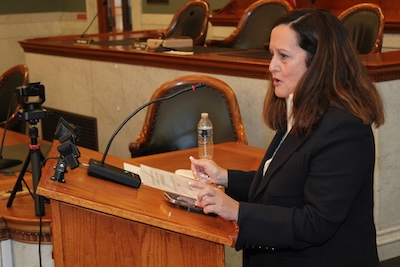
Throughout the day, the theme of advocacy resonated strongly. Speakers repeatedly emphasized that social workers play a critical role in shaping policy and promoting equity. That message was central to State Senator Rachel May’s (D-48) remarks, which highlighted the importance of practitioners’ on-the-ground experience in guiding effective responses to the inevitable cutbacks that she foresaw.
“We want to do everything we can to support students through counseling, after-school programs, and opportunities that let them thrive,” she observed. “New York State will need to be strategic—and we need your expertise to guide us.”
The value of that experience also came through in the two panels that closed out the day. Social work faculty joined other professionals to share insight from a range of initiatives centering support for students and families in the area, such as the collaboration between SUNY Upstate Medical University and the Syracuse City School District, aiming to establish school-based clinics, develop training pipelines for mental health professionals, and cultivate counselors from a wide range of backgrounds.
When panelists were asked to describe an idealized scenario of the future, Associate Professor Ryan Heath noted that the current funding crisis is a “manufactured” one, rooted in political priorities rather than a true lack of resources. The vision he described was of a cultural shift that would truly value caregivers for their indispensable work.
It was a vision fitting to the spirit of the day, which highlighted the importance of social workers and affirmed the necessity of their intervention in the spaces between policy and lived lives.
By Sarah H. Griffin